





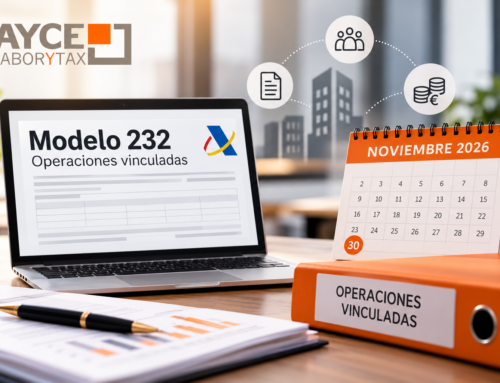
Companies that carried out related-party transactions during the 2025 financial year should review whether they are required to file Spain’s Model 232. For entities whose financial year coincides with the calendar year, the filing deadline is 30 November 2026.
November is an important month in the Spanish corporate tax calendar. One of the key reporting obligations that businesses should be aware of is Model 232 (Modelo 232), the annual information return for related-party transactions and transactions or arrangements involving non-cooperative jurisdictions.
Although Model 232 is an information return and does not, in itself, result in a tax payment, accurate and timely filing is essential to ensure compliance with Spanish tax regulations and minimise the risk of potential issues with the Spanish Tax Agency (Agencia Tributaria or AEAT).
At AYCE Laborytax, we would like to remind companies of the relevant deadlines, reporting thresholds and key considerations to review before submitting this return.
1. When Is Model 232 Due in Spain in 2026?
The filing period for Model 232 relating to the 2025 financial year runs from 1 to 30 November 2026, provided that the company’s financial year coincides with the calendar year.
Therefore, Monday, 30 November 2026, is the filing deadline for companies falling within this category.
Where a company’s financial year does not coincide with the calendar year, Model 232 must generally be submitted during the month following the ten-month period after the end of the relevant tax year.
Companies are strongly advised not to leave their review until the final days of the filing period, particularly where several related entities, international transactions or different transfer pricing methods are involved.
2. What Is Spain’s Model 232 and What Is Its Purpose?
Model 232 is an annual information return submitted to the Spanish Tax Agency through which certain taxpayers must disclose transactions carried out with related individuals or entities, as well as specific transactions and arrangements involving non-cooperative jurisdictions.
Its purpose is to provide the Spanish tax authorities with information on these transactions and strengthen oversight of compliance with applicable tax regulations.
Transactions that may be subject to reporting include:
- Services provided between companies belonging to the same corporate group.
- Intercompany loans and financing arrangements.
- Property leases between related parties.
- Purchases and sales of goods and other assets.
- Licensing or transfers of intellectual and industrial property rights.
- Certain transactions between shareholders and their companies.
Not all related-party transactions must automatically be reported under Model 232. Each transaction must be assessed according to the relationship between the parties, its nature and the applicable statutory thresholds.
3. Who Is Required to File Model 232 in Spain?
The filing obligation may apply to Spanish Corporate Income Tax taxpayers, certain permanent establishments of non-resident entities and certain foreign entities operating in Spain under an income attribution regime.
As a general rule, companies should assess whether they are required to file Model 232 when they have carried out the following transactions:
| Type of transaction | Reporting threshold |
|---|---|
| Transactions with the same related individual or entity | When the aggregate value of transactions exceeds €250,000. |
| Specific categories of related-party transactions | When the aggregate value of each specific type of transaction exceeds €100,000. |
| Transactions of the same type valued using the same transfer pricing method | When the aggregate value of transactions exceeds 50% of the entity’s turnover, regardless of the thresholds mentioned above. |
These thresholds must be assessed in accordance with the applicable regulations, taking into account that certain transactions are excluded and that specific reporting obligations may apply regardless of the transaction amount.
Important: A company that does not exceed the €250,000 threshold with an individual related party is not necessarily exempt from filing Model 232.
Other reporting criteria may still apply.
4. What Qualifies as a Related-Party Transaction?
Related-party transactions are transactions between individuals or entities that have certain ownership, management, economic or control relationships as defined under the Spanish Corporate Income Tax Law.
Depending on the circumstances, related-party relationships may exist between:
- A company and its shareholders, where the statutory ownership requirements are met.
- A company and its directors, subject to the specific provisions established by law.
- Two companies belonging to the same corporate group.
- Companies linked through ownership or control relationships recognised under Spanish tax legislation.
One of the fundamental principles governing related-party transactions is that they must be valued at arm’s length, meaning that the agreed terms and prices should be consistent with those that would have been established between independent parties under comparable circumstances.
Consequently, in addition to determining whether Model 232 must be filed, companies should review the valuation of their related-party transactions and any applicable transfer pricing documentation requirements.
5. Which Specific Transactions Require Particular Attention?
Spanish tax regulations establish a special €100,000 threshold for certain categories of related-party transactions.
These may include:
- Transactions involving individuals taxed under the objective assessment regime, where certain ownership requirements are met.
- Transfers of businesses.
- Certain transfers of shares or equity interests.
- Transfers of real estate.
- Transactions involving intangible assets.
Specific reporting requirements may also apply where a company benefits from the tax reduction available for certain income derived from intangible assets licensed or transferred to related entities.
Furthermore, transactions and arrangements involving non-cooperative jurisdictions may be subject to reporting regardless of their amount, in accordance with the applicable rules.
Companies should therefore examine the nature of their transactions carefully rather than relying exclusively on general monetary thresholds.
6. How Is Model 232 Filed?
Model 232 must be submitted electronically through the Spanish Tax Agency’s online platform.
Before submitting the return, companies should verify the following information:
- Identification of the related individuals or entities involved.
- Nature of the relationship between the parties.
- Type and value of each reportable transaction.
- Appropriate separation of income and expense transactions.
- Transfer pricing methods applied.
- Consistency between the information reported, the company’s accounting records and its Corporate Income Tax return.
A thorough review before submission can help identify discrepancies, reduce reporting errors and ensure that the information provided is accurate and complete.
7. What Happens if a Company Fails to File Model 232?
Failure to submit Model 232, late filing or the submission of incorrect or incomplete information may result in tax-related consequences and, where applicable, penalties under the Spanish General Tax Law.
The specific consequences depend on the nature and circumstances of the non-compliance.
It is also important to distinguish between the information reporting requirements under Model 232 and the separate obligations relating to the valuation and documentation of related-party transactions.
Filing Model 232 does not replace the obligation to prepare and maintain transfer pricing documentation where such documentation is required.
Companies should therefore consider both obligations as part of their overall tax compliance procedures.
8. Key Recommendations for Companies Before 30 November 2026
At AYCE Laborytax, we recommend that companies which carried out related-party transactions during 2025 review their position well before the filing deadline.
Particular attention should be paid to:
- Transactions between companies belonging to the same group.
- Intercompany loans and financing arrangements.
- Intragroup management and administrative services.
- Property leases involving related parties.
- Transactions between companies and their shareholders.
- Cross-border transactions involving foreign group companies.
International related-party transactions may require additional analysis from a transfer pricing perspective, particularly where several jurisdictions are involved.
Appropriate tax planning and a timely review of the relevant transactions can help businesses identify their reporting obligations, ensure consistency with their accounting records and minimise the risk of non-compliance.
9. Frequently Asked Questions About Model 232 in Spain
What is the deadline for filing Model 232 in 2026?
The deadline is 30 November 2026 for companies whose financial year coincides with the calendar year. The return relates to reportable transactions carried out during 2025.
Do all companies in Spain have to file Model 232?
No. The filing obligation depends on the nature and amount of the transactions, the relationship between the parties and the specific reporting requirements established under Spanish tax legislation.
Does Model 232 have to be filed even if no tax is payable?
Yes, where the company is subject to the reporting obligation. Model 232 is an information return rather than a tax return requiring payment.
Must intercompany loans be reported under Model 232?
They may be subject to reporting. Companies should review the amount and characteristics of the financing arrangement, the relationship between the entities and the applicable reporting thresholds.
Are small companies required to file Model 232?
Potentially, yes. The size of the company does not, by itself, determine whether the filing obligation applies. Small and medium-sized enterprises may also be required to submit Model 232 if they carry out transactions that meet the relevant statutory conditions.
Is filing Model 232 the same as preparing transfer pricing documentation?
No. These are separate tax compliance obligations.
Submitting Model 232 does not replace the requirement to prepare and maintain transfer pricing documentation where applicable.
Can foreign-owned companies in Spain be required to file Model 232?
Yes. Spanish subsidiaries of international groups may be required to file Model 232 when they carry out reportable transactions with related entities, including their foreign parent companies or other group companies.
Each situation should be assessed in accordance with the applicable Spanish tax regulations.
10. AYCE Laborytax: Corporate Tax Advisory and Related-Party Transaction Compliance in Spain
The correct identification, valuation and reporting of related-party transactions requires a thorough understanding of Spanish tax legislation and the specific circumstances of each business.
At AYCE Laborytax, our experienced corporate tax advisory team supports Spanish companies, foreign-owned subsidiaries and international corporate groups in meeting their tax compliance obligations in Spain.
Our professionals can assist your business with:
- Reviewing related-party transactions and applicable reporting thresholds.
- Determining whether Model 232 must be filed.
- Preparing and submitting Model 232 to the Spanish Tax Agency.
- Reviewing tax compliance matters relating to intercompany transactions.
- Assessing transfer pricing considerations and coordinating specialist support where required.
We understand the challenges faced by international businesses operating in Spain and the importance of accurate, timely and reliable tax reporting.
Important reminder: If your company is required to file Model 232 for the 2025 financial year and its financial year coincides with the calendar year, the filing deadline is 30 November 2026.
DO YOU HAVE ANY QUESTIONS ABOUT MODEL 232 OR YOUR COMPANY’S RELATED-PARTY TRANSACTIONS IN SPAIN?
CONTACT AYCE LABORYTAX. OUR CORPORATE TAX ADVISORY TEAM WILL BE PLEASED TO ASSIST YOU.
This article provides general information on Spanish tax reporting obligations and does not constitute individual tax advice. Each company’s circumstances should be reviewed separately.



Deja tu comentario