




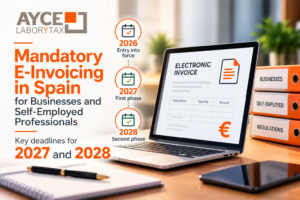
Mandatory electronic invoicing between businesses and professionals now has an official implementation timetable in Spain. The publication of Ministerial Order HAC/1028/2026, which entered into force on 6 October 2026, marks the beginning of the countdown for companies, SMEs and self-employed professionals to adapt their invoicing systems.
The new regulations, introduced under Spain’s Create and Grow Law (Ley Crea y Crece), will significantly change how invoices are issued, received and managed in business-to-business (B2B) transactions.
But when will electronic invoicing become mandatory? Will self-employed professionals also be affected? Will businesses still be allowed to send invoices in PDF format? And how does the new system relate to VeriFactu?
At AYCE Laborytax, we explain the official deadlines, the main compliance obligations and the practical steps businesses should consider when preparing for the transition.
1. When Will Electronic Invoicing Become Mandatory in Spain?
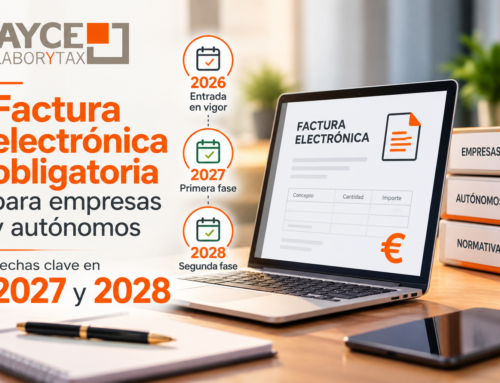
The implementation of mandatory B2B electronic invoicing will take place in stages, depending on each business’s annual turnover for VAT purposes.
The entry into force of Ministerial Order HAC/1028/2026 on 6 October 2026 triggers the implementation periods established under Royal Decree 238/2026.
These are the key dates businesses should mark in their calendars:
| Date | Businesses affected | Requirement |
|---|---|---|
| 6 October 2027 | Businesses and professionals with an annual volume of transactions exceeding €8 million | Issue and receive electronic invoices and report invoice statuses and payments |
| 6 October 2028 | All other businesses and professionals | Issue and receive electronic invoices |
| 6 October 2028 | Legal entities with an annual volume of transactions of €8 million or less | Report invoice statuses and payments |
| 6 October 2029 | Individuals carrying on business activities and entities subject to the income attribution regime | Report invoice statuses and payments |
The €8 million threshold is determined by reference to the volume of transactions defined in Article 121 of the Spanish VAT Law, based on the preceding calendar year.
Practical example: a company whose volume of transactions exceeds €8 million in 2026 must comply with the new B2B electronic invoicing system from 6 October 2027.
By contrast, an SME with an annual volume of transactions of €1.5 million will generally have until 6 October 2028 to comply.
2. What Is B2B Electronic Invoicing and Why Is It Becoming Mandatory?
B2B electronic invoicing refers to invoices issued and received in a structured electronic format in commercial transactions between businesses and professionals.
Unlike traditional paper invoices or conventional PDF documents, structured electronic invoices allow invoicing data to be processed automatically by accounting and business management systems.
The new regulations pursue three main objectives:
- Digitalising business administration, reducing manual processes and facilitating the electronic exchange of information.
- Improving invoice traceability, allowing businesses to monitor invoice statuses and certain payment-related events.
- Combating late payments, enabling more effective monitoring of payment periods in commercial transactions.
The introduction of mandatory electronic invoicing therefore represents much more than replacing paper invoices with digital documents.
It will also affect internal administrative procedures, accounting workflows and accounts receivable management.
3. Which Businesses and Self-Employed Professionals Must Issue Electronic Invoices?
As a general rule, the obligation will apply to businesses and professionals required to issue invoices for transactions with other businesses or professionals established in Spain, subject to the conditions laid down in the regulations.
This includes large corporations, SMEs, microbusinesses and self-employed professionals.
Does this mean that every invoice must be electronic?
Not necessarily.
The new obligation primarily concerns B2B transactions, meaning commercial operations between businesses and professionals that fall within the scope of the regulations.
Transactions involving private consumers (B2C) do not automatically become subject to the new B2B electronic invoicing requirements.
Certain exceptions also apply, including specific transactions documented through simplified invoices.
Businesses should therefore assess which of their transactions fall within the scope of the new rules and determine the requirements applicable to their activities.
4. Will Businesses Still Be Allowed to Send PDF Invoices?
This is one of the most frequently asked questions among companies and self-employed professionals.
A conventional PDF invoice does not qualify as a structured electronic invoice under the new B2B system.
Many businesses currently consider themselves to be using electronic invoicing because they send invoices by email in PDF format.
However, the new regulations require structured formats that enable the automatic processing of invoice data.
Which Electronic Invoice Formats Will Be Accepted?
The regulations recognise several structured electronic formats, including:
- UBL (Universal Business Language).
- Facturae.
- CII (Cross Industry Invoice).
- EDIFACT.
These formats must comply with the applicable technical and interoperability requirements.
Will PDF Invoices Disappear Completely?
Not immediately.
During the first 12 months following the application of the new rules to businesses with an annual volume of transactions exceeding €8 million, electronic invoices must be accompanied by a readable PDF representation unless the recipient expressly agrees to receive only the original structured electronic format.
This transitional measure is intended to facilitate adaptation for businesses and their customers.
The key point is that, in these circumstances, the PDF will serve as a supplementary document rather than a substitute for the structured electronic invoice.
5. How Will Spain’s New Electronic Invoicing System Work?
Under the new framework, businesses will be able to use either private electronic invoicing platforms or the public electronic invoicing solution developed by the Spanish Tax Agency.
Companies may choose the option that best suits their operational requirements, provided it complies with the applicable regulations.
Public Electronic Invoicing Solution Managed by the Spanish Tax Agency
The Spanish Tax Agency (Agencia Estatal de Administración Tributaria, or AEAT) will operate a public electronic invoicing solution designed to support transactions within the new system.
The solution aims to facilitate regulatory compliance and the electronic exchange of invoices.
Private Electronic Invoicing Platforms
Businesses may also continue using private invoicing software and technology platforms, provided these are adapted to the new requirements.
However, such platforms must comply with the established interoperability and connectivity standards.
Where private platforms are used, faithful copies of issued invoices must be transmitted to the public electronic invoicing solution in accordance with the applicable requirements.
This means that having software capable of generating invoices will not, in itself, be sufficient. Businesses must ensure that their systems also meet the technical, interoperability and reporting obligations of the new framework.
6. An Important New Requirement: Reporting Invoice Statuses and Payments
The new regulations do more than establish how invoices must be issued and received.
They also introduce obligations relating to the communication of invoice statuses and actual payments.
Depending on the applicable conditions and deadlines, businesses will be required to report information such as invoice rejection and the date on which payment is effectively made.
The regulations establish reporting periods of four calendar days, subject to the specified exclusions for Saturdays, Sundays and national public holidays.
Why is this important?
Because it will provide more accurate information about commercial payments and help improve the monitoring of late payment practices.
From an operational perspective, businesses will need to review their internal invoice approval procedures, treasury processes and payment reconciliation systems.
The dates on which these reporting obligations become enforceable vary according to the type of taxpayer and their annual volume of transactions, with certain obligations taking effect as late as October 2029.
7. Are B2B Electronic Invoicing and VeriFactu the Same Thing?
No. Although both initiatives are part of Spain’s wider digitalisation of invoicing, mandatory B2B electronic invoicing and VeriFactu address different regulatory requirements.
Understanding this distinction is particularly important when adapting business invoicing software.
| Mandatory B2B Electronic Invoicing | VeriFactu and Invoicing Software Regulations |
|---|---|
| Regulates the issuance, transmission and receipt of invoices between businesses and professionals | Establishes technical requirements for computerised invoicing systems |
| Aims to digitalise commercial transactions and improve payment monitoring | Aims to ensure the integrity, traceability and immutability of invoicing records |
| Developed under Spain’s Create and Grow Law | Developed within Spain’s tax fraud prevention framework |
| B2B implementation begins in October 2027 and continues in 2028 | Subject to a separate implementation timetable and scope of application |
A business may therefore need to adapt its software to comply with both regulatory frameworks.
However, their requirements and implementation deadlines should not be confused.
Our recommendation is to assess both sets of obligations together to avoid unnecessary duplication and select compatible invoicing solutions.
8. How Should Businesses Prepare for Mandatory Electronic Invoicing?
Although the first mandatory requirements will apply from October 2027, businesses should use the available transition period to prepare.
At AYCE Laborytax, we recommend taking the following steps.
Review Your Current Invoicing Software
The first step is to contact your technology provider and confirm whether your existing software will be capable of issuing and receiving structured electronic invoices.
Businesses should also verify compatibility with the applicable interoperability, connectivity and reporting requirements.
Assess Your Invoice Receipt Procedures
The transition will not only affect invoices issued by a business.
Companies will also need to organise how electronic invoices are received, validated, recorded in their accounting systems and stored.
Review Accounts Receivable and Payment Procedures
The obligation to report certain invoice statuses will require businesses to maintain up-to-date information and appropriate administrative procedures.
Coordinate the Departments Involved
Implementation may require cooperation between administration, accounting, tax, treasury and IT departments.
For smaller businesses, effective coordination between the business owner, external advisers and software provider will be particularly important.
Plan the Transition in Advance
Waiting until the final weeks before the relevant deadline may create unnecessary operational difficulties.
A properly planned transition will allow businesses to test their systems, train employees and minimise potential disruptions.
9. Frequently Asked Questions About Mandatory Electronic Invoicing in Spain
When Will Electronic Invoicing Become Mandatory for SMEs in Spain?
As a general rule, SMEs and businesses with an annual volume of transactions of €8 million or less must issue and receive B2B electronic invoices from 6 October 2028.
When Will Electronic Invoicing Become Mandatory for Self-Employed Professionals?
Self-employed professionals within the scope of the regulations must generally issue and receive B2B electronic invoices from 6 October 2028, unless their volume of transactions makes an earlier deadline applicable.
For certain individuals, the obligation to report invoice statuses and payments will become enforceable from 6 October 2029.
Can Businesses Continue Sending Invoices in PDF Format?
A conventional PDF does not replace the structured electronic invoice required under the new B2B system.
A specific transitional arrangement allows structured electronic invoices to be accompanied by a readable PDF representation under the applicable conditions.
Will Businesses Have to Replace Their Invoicing Software?
This will depend on whether their existing software can be adapted to meet the new technical requirements.
Businesses should consult their software provider before deciding whether a replacement is necessary.
Will Electronic Invoicing Be Mandatory for Invoices Issued to Private Consumers?
The new B2B obligation applies to transactions between businesses and professionals.
It does not, by itself, require all invoices issued to private consumers to be processed through the new B2B electronic invoicing system.
What Is the Difference Between VeriFactu and Mandatory Electronic Invoicing?
VeriFactu relates to the technical requirements applicable to computerised invoicing systems, while mandatory B2B electronic invoicing governs the structured electronic exchange of invoices between businesses and professionals.
10. Conclusion: Mandatory Electronic Invoicing Now Has a Timetable, and Businesses Should Start Preparing
The publication of Ministerial Order HAC/1028/2026 represents a significant step towards the implementation of mandatory electronic invoicing between businesses and professionals in Spain.
With the first requirements scheduled for October 2027 and their wider implementation in October 2028, businesses have time to review their systems and prepare their internal administrative procedures.
However, compliance should not be viewed simply as a matter of introducing new software.
Mandatory electronic invoicing will transform how businesses issue, receive, record and manage the payment of invoices. It is therefore advisable to approach the transition from a combined tax, accounting and technology perspective.
Is Your Business Ready for Mandatory Electronic Invoicing in Spain?
At AYCE Laborytax, we help companies, SMEs and self-employed professionals adapt to regulatory changes and improve their tax and accounting processes.
Our team of specialists can support your business in reviewing its compliance obligations and coordinating the solutions needed to prepare for the transition to electronic invoicing.
Contact AYCE Laborytax and prepare your business for Spain’s new electronic invoicing requirements with confidence and peace of mind.
Deja tu comentario