




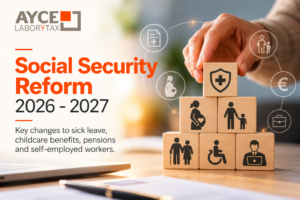
Spain’s Royal Decree-Law 31/2026 introduces significant changes to the Social Security system, affecting employees, employers and self-employed professionals. Key developments include the recognition of new special categories of temporary incapacity for work, enhanced benefits for parents caring for children with serious illnesses, and amendments to survivors’ pensions.
Published in Spain’s Official State Gazette (Boletín Oficial del Estado, BOE) on 21 October 2026, the legislation amends several provisions of the Spanish General Social Security Act and the Workers’ Statute. The new measures are being implemented progressively between October 2026 and January 2027.
What exactly is changing, and how will these developments affect businesses and their employees in Spain?
At AYCE Laborytax, we examine the most significant regulatory changes and explain their practical implications for employers, HR departments, payroll teams and self-employed professionals.
1. Changes to Temporary Incapacity and Sick Leave Benefits
One of the main areas affected by the reform is temporary incapacity for work (Incapacidad Temporal, IT), which covers situations in which an employee is temporarily unable to perform their professional duties due to health-related reasons.
The new legislation introduces changes to both the calculation of temporary incapacity benefits and the recognition of additional circumstances requiring specific Social Security protection.
How will temporary incapacity benefits be calculated?
As a general rule, the regulatory base used to calculate temporary incapacity benefits will be determined by reference to the employee’s Social Security contribution base for the month immediately preceding the month before the start of their medical leave.
Practical example:
If an employee begins certified sick leave in December 2026, the calculation will be based on their Social Security contribution base for October 2026, rather than November, in accordance with the new rules.
However, specific provisions apply to employees who have recently joined a company:
- Employees registered with the company during the month preceding sick leave: The contribution base for that month will be used.
- Employees registered during the same month in which sick leave begins: The calculation will take into account the contributions corresponding to the period between their registration date and the day immediately preceding the start of medical leave.
These changes will require employers, payroll providers and HR departments to review their benefit calculation procedures to ensure compliance with the updated requirements.
New protected categories of sick leave: menopause-related conditions and gender-based violence
The reform introduces two additional special categories of temporary incapacity arising from non-occupational contingencies.
Sick leave for secondary menopausal disorders
The legislation recognises duly classified secondary menopausal disorders as a special category of temporary incapacity where the employee requires medical care from the Spanish Public Health Service and is medically unable to carry out her professional duties.
Importantly, menopause itself does not automatically entitle an employee to sick leave. A medically recognised condition must exist, and the applicable statutory and clinical requirements must be satisfied.
Sick leave resulting from gender-based violence
A further special category of temporary incapacity is introduced for injuries resulting from gender-based violence committed by a current or former spouse or intimate partner, regardless of whether the individuals have lived together.
Eligibility will require an appropriate medical assessment and identification of the circumstances through the relevant medical classification procedures.
Is a minimum contribution period required?
For these two newly recognised categories, no minimum prior Social Security contribution period is required.
Furthermore, as a general rule, the Social Security benefit will become payable from the day following the commencement of sick leave, while the employer remains responsible for paying the employee’s full salary for the first day of absence.
These measures are intended to strengthen financial protection for women facing particularly vulnerable circumstances.
What happens during strikes or employer lockouts?
The updated legislation expressly maintains that employees are not entitled to temporary incapacity cash benefits during periods of industrial action or employer lockouts, subject to the applicable statutory provisions.
Reduced Social Security contributions for employers of workers aged 62 and over
The reform also introduces a measure of particular relevance to employers.
During periods of temporary incapacity affecting employees aged 62 or over, companies may qualify for a 75% reduction in employer Social Security contributions for common contingencies, provided the applicable legal conditions are met.
The general obligation to maintain Social Security contributions during temporary incapacity remains in force.
Effective date: 1 December 2026.
2. Enhanced Benefits for Parents Caring for Children with Cancer or Other Serious Illnesses
Another significant development concerns families who need to reduce their working hours to care for children or dependent minors affected by cancer or other serious medical conditions.
The reform broadens access to the relevant Social Security benefit and introduces greater flexibility for both caregivers.
Hospitalisation will no longer be mandatory in certain circumstances
Previously, hospitalisation was one of the central requirements for accessing this benefit.
Under the new provisions, entitlement may also be recognised where a child is not hospitalised but requires medical treatment of an equivalent level of intensity, making direct, continuous and permanent care necessary.
This change seeks to reflect the reality of modern healthcare, where complex or intensive medical treatment may take place outside a hospital setting.
Exceptional extension of benefits beyond the age of 26
The reform also provides for the exceptional continuation of benefits where the person requiring care is over 26 years of age.
This extension will be subject to the statutory requirements, including:
- A recognised disability rating of at least 65%, or a Grade III dependency classification under the Spanish dependency assessment system.
- The continued need for direct, continuous and permanent care.
- Continued cohabitation and compliance with the remaining eligibility conditions.
Can both parents receive the benefit at the same time?
Yes. One of the most significant developments is the possibility for both eligible caregivers to receive the benefit either alternately or simultaneously, provided the relevant legal conditions are met.
Where both caregivers receive the benefit simultaneously, each beneficiary will be entitled to a payment equivalent to 50% of their respective regulatory base for temporary incapacity arising from occupational contingencies, regardless of the applicable percentage reduction in working hours.
This measure promotes a more balanced sharing of family responsibilities and provides greater flexibility when organising the care of children with serious medical conditions.
Effective date: 23 October 2026.
3. Changes to Widows’, Widowers’ and Orphans’ Pensions
The reform also introduces amendments intended to strengthen financial protection for families, particularly unmarried couples and children affected by deaths resulting from violence against women.
Survivors’ pensions for unmarried partners: what is changing?
The new legislation relaxes certain evidentiary requirements for establishing the existence of a legally recognised unmarried partnership for the purposes of entitlement to a survivor’s pension.
One of the main changes is the possibility of demonstrating a stable and publicly acknowledged relationship through an official municipal registration certificate (certificado de empadronamiento), provided the relevant statutory conditions are satisfied.
Where required, the couple must have lived together continuously for at least five years immediately preceding the deceased partner’s death.
The legislation also establishes specific provisions for couples with children in common.
What does this mean in practice?
These amendments may facilitate access to survivors’ pensions for individuals who have maintained a stable, long-term relationship without formally registering their partnership through the mechanisms traditionally required.
Nevertheless, entitlement will remain subject to compliance with all other applicable legal requirements.
Greater protection through orphans’ pensions and benefits
The reform also strengthens the rights of children whose mothers have died as a result of violence against women or certain offences involving sexual violence.
The main measures include:
- Broader access to orphanhood benefits where the eligibility requirements for a contributory orphan’s pension are not met.
- The establishment, in the circumstances specified by law, of a reference amount equivalent to twice the prevailing monthly Spanish statutory minimum wage (Salario Mínimo Interprofesional, SMI).
- The preservation of entitlement to certain orphans’ pensions following a subsequent adoption.
- New rules governing incompatibilities where a subsequent adoption could give rise to an additional entitlement to an orphan’s pension.
These measures seek to prevent situations of financial vulnerability and reinforce protection for children and other eligible beneficiaries affected by particularly serious circumstances.
4. Changes Affecting Self-Employed Workers from 2027
Self-employed professionals operating in Spain will also be affected by the reform, particularly regarding the calculation of temporary incapacity benefits and the annual adjustment of Social Security contribution bases.
New calculation method for self-employed sick leave benefits
Under the new rules, the regulatory base for temporary incapacity benefits for self-employed workers will generally be calculated using the Social Security contribution base for the month immediately preceding the month before the event giving rise to entitlement, divided by 30.
Practical example:
A self-employed professional begins certified sick leave in February 2027.
Their Social Security contribution base for December 2026 was €1,500.
The daily regulatory base would therefore be:
€1,500 ÷ 30 days = €50 per day.
This amount represents the regulatory base, not necessarily the final daily benefit payable. The actual payment will depend on the applicable benefit percentage and the circumstances of the medical leave.
The legislation also establishes specific calculation rules for individuals who have recently registered under Spain’s Special Social Security Scheme for Self-Employed Workers (Régimen Especial de Trabajadores Autónomos, RETA).
Changes to the annual adjustment of Social Security contribution bases
Another important amendment concerns the annual reconciliation of Social Security contributions for self-employed workers.
The reform expands and clarifies the circumstances in which contribution bases become definitive and are no longer subject to subsequent adjustment.
Protected circumstances include caring for children affected by cancer or other serious illnesses, alongside other benefits and situations such as:
- Temporary incapacity for work.
- Birth and childcare.
- Risks during pregnancy.
- Risks during breastfeeding.
The objective is to provide greater legal certainty regarding the contribution bases used to calculate certain Social Security benefits.
Effective date: 1 January 2027, in relation to the amendment of Article 309 of the Spanish General Social Security Act.
5. Implementation Timeline: When Will the Changes Take Effect?
Not all the measures introduced by Royal Decree-Law 31/2026 will apply from the same date.
| Effective date | Main changes |
|---|---|
| 21 October 2026 | General entry into force of Royal Decree-Law 31/2026 |
| 23 October 2026 | Changes to benefits for caring for children with cancer or other serious illnesses |
| 1 November 2026 | Application of certain amendments concerning extraordinary pensions |
| 1 December 2026 | New special categories of temporary incapacity and changes to benefit calculations |
| 1 January 2027 | New rules governing the reconciliation of self-employed workers’ Social Security contribution bases |
Identifying the correct implementation date for each measure is essential, particularly for payroll administration, sick leave management and Social Security benefit processing.
6. How Will These Changes Affect Employers and HR Departments in Spain?
Although some of the amendments primarily concern individual benefit entitlements, their implementation will also have practical consequences for employers.
At AYCE Laborytax, we recommend that businesses pay particular attention to three areas.
Review sick leave management procedures
Changes to regulatory bases and the recognition of new categories of temporary incapacity may require adjustments to payroll software, benefit calculations and internal administrative processes.
Employers should ensure that their payroll and HR teams are familiar with the new requirements and apply the correct rules from the relevant effective dates.
Update procedures for managing reduced working hours
The new arrangements for benefits relating to the care of children with serious illnesses make it necessary to review how requests for reduced working hours are assessed, approved and administered.
HR departments should ensure that their procedures reflect the expanded eligibility criteria and the possibility of simultaneous benefit entitlement for both caregivers.
Prepare for the changes taking effect in 2027
Self-employed professionals and their advisers should consider the new contribution and reconciliation rules to avoid errors in the calculation of Social Security benefits.
Early preparation will help businesses and individuals adapt smoothly to the new regulatory framework.
Proper implementation of these changes can reduce administrative errors, strengthen legal certainty and support effective compliance with Spanish employment and Social Security obligations.
For international companies operating in Spain, understanding these requirements is particularly important, as Spanish payroll and Social Security rules may differ significantly from those applicable in other jurisdictions.
7. Frequently Asked Questions About Spain’s 2026–2027 Social Security Reform
When does Royal Decree-Law 31/2026 come into force?
The legislation entered into force on 21 October 2026. However, certain measures have specific implementation dates, including 23 October, 1 November and 1 December 2026, and 1 January 2027.
Can an employee take sick leave due to menopause?
The reform recognises duly classified secondary menopausal disorders as a special category of temporary incapacity, provided the employee requires medical care and is medically unable to work.
Menopause alone does not automatically establish entitlement to sick leave.
How will sick leave benefits be calculated from December 2026?
As a general rule, the calculation will be based on the employee’s Social Security contribution base for the month immediately preceding the month before the start of medical leave.
Specific exceptions apply to employees who have recently joined the company.
Can both parents receive benefits for caring for a child with cancer?
Yes. The reform allows both eligible caregivers to receive the benefit simultaneously, subject to the statutory requirements.
In such cases, each beneficiary will receive an amount equivalent to 50% of their respective regulatory base.
What changes will affect self-employed workers in 2027?
The principal developments include new rules for calculating temporary incapacity benefits and amendments to the annual reconciliation of certain Social Security contribution bases used to determine benefit entitlements.
8. Conclusion: Why Employers Should Review Their Payroll and Social Security Procedures
Royal Decree-Law 31/2026 introduces significant changes to Spain’s Social Security framework, strengthening protection for employees and self-employed professionals while expanding certain rights relating to health, family care and survivors’ benefits.
For businesses, these developments reinforce the importance of keeping employment procedures up to date and obtaining specialist advice to ensure that legislative changes are implemented correctly.
At AYCE Laborytax, our dedicated Employment Advisory and Payroll Services team supports Spanish and international businesses in managing their employment obligations, adapting to regulatory developments and maintaining compliance with Spanish Social Security requirements.
Whether your company is already operating in Spain, employs staff locally or is planning to establish a presence in the Spanish market, our specialists can help you understand the implications of these changes and manage your obligations efficiently.
Do you need assistance with Spanish payroll, employment compliance or Social Security matters?
Contact AYCE Laborytax today. Our team will be pleased to provide the professional guidance and practical support your business needs to navigate Spain’s evolving employment and Social Security regulations with confidence.

Deja tu comentario